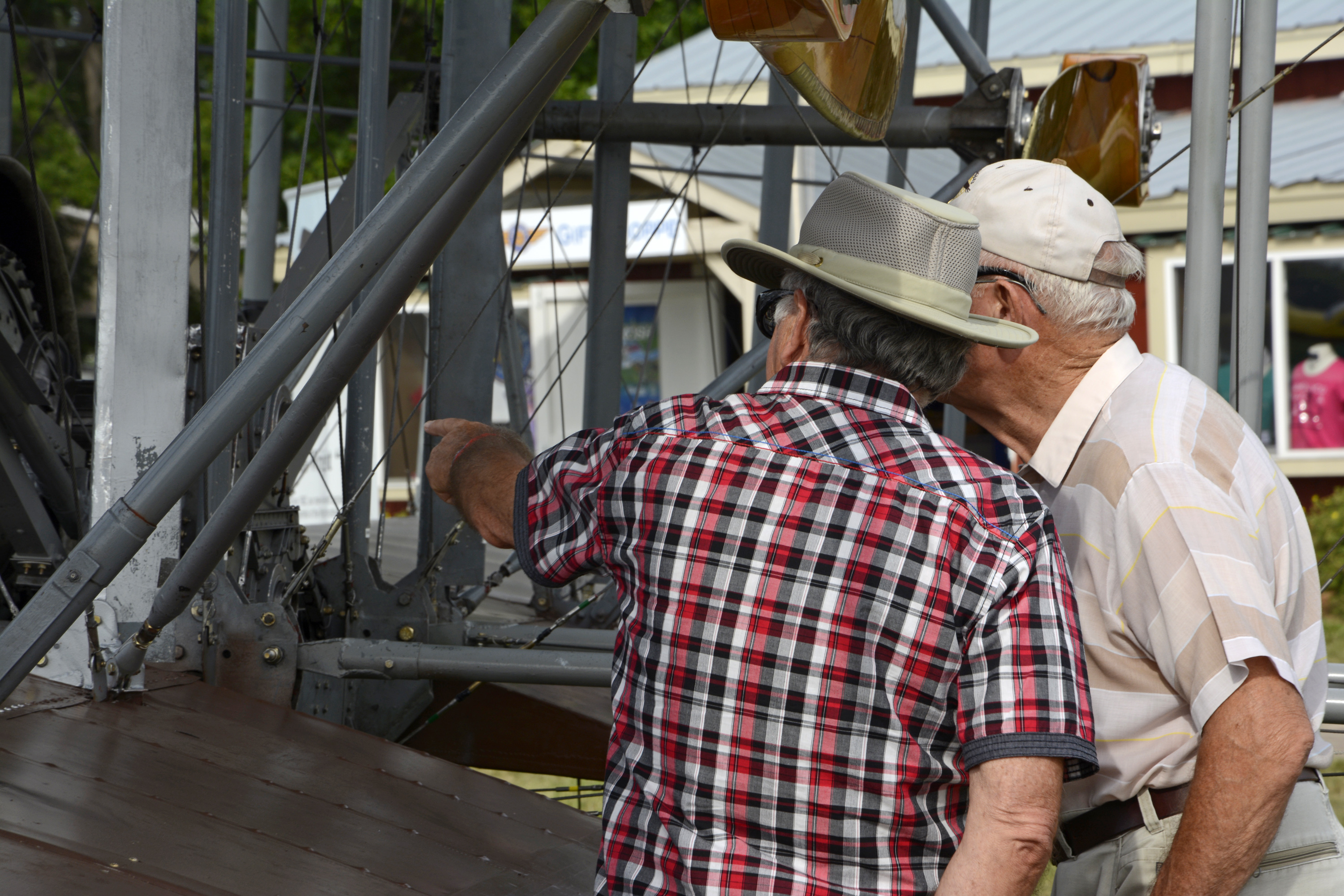
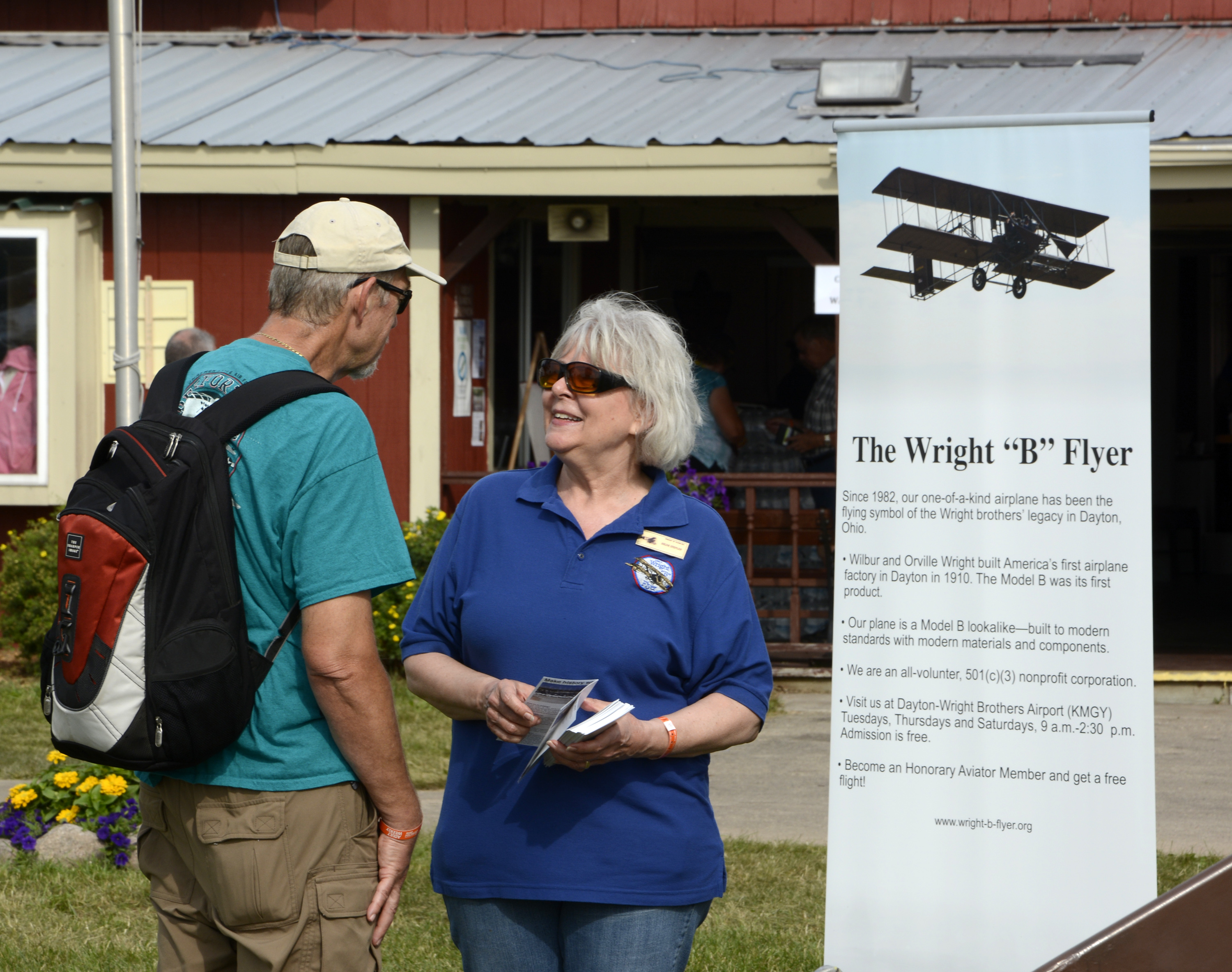
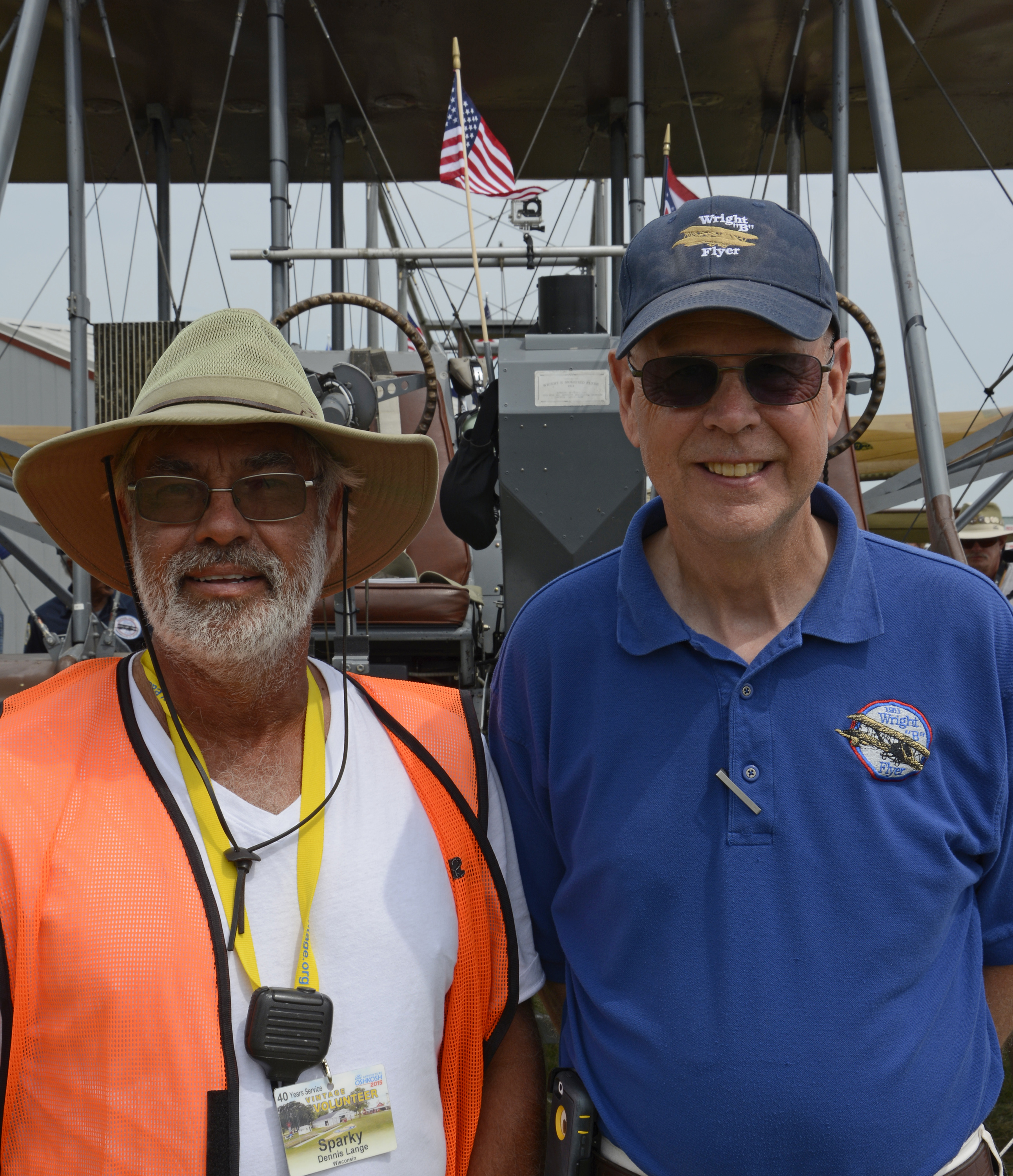
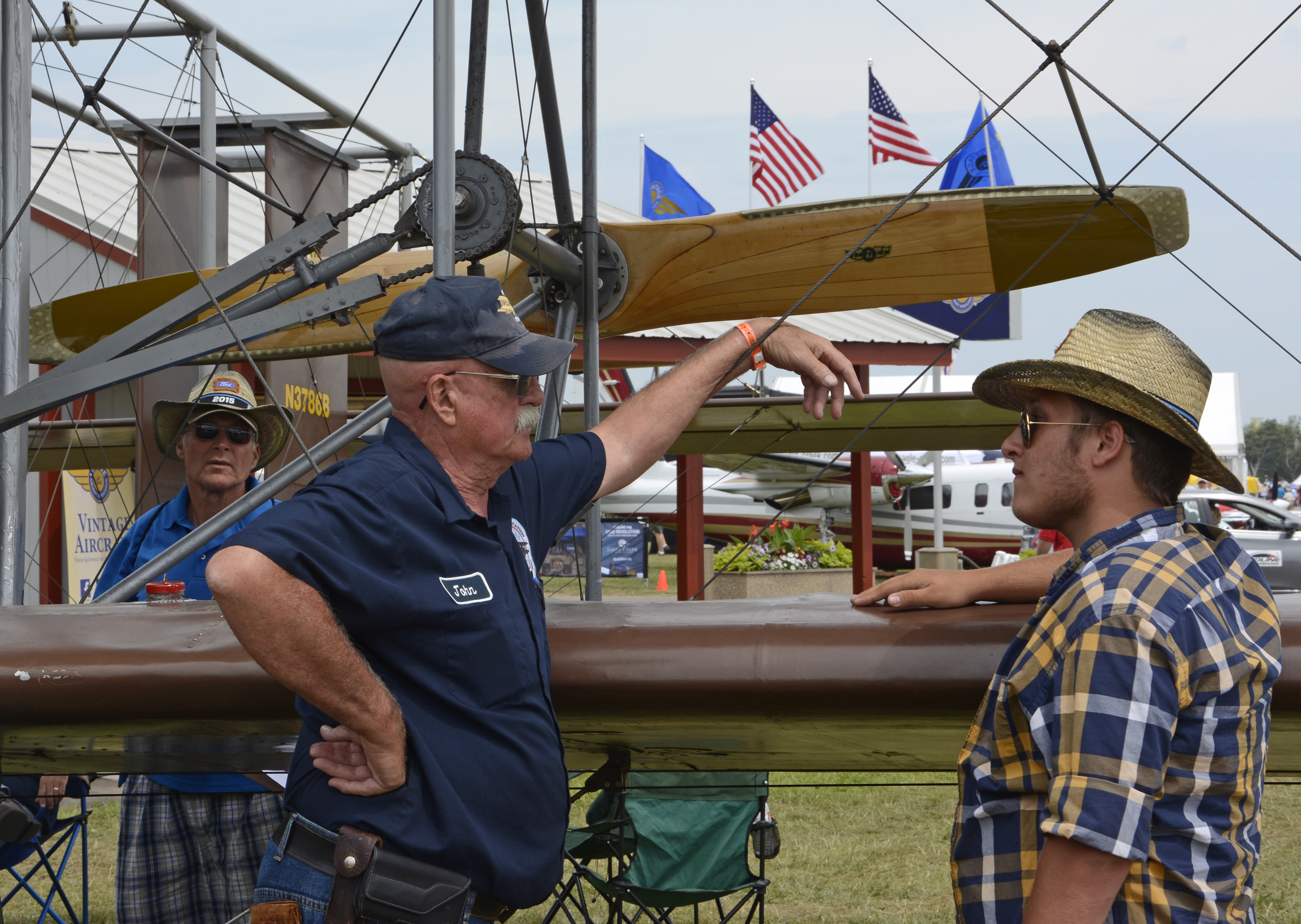
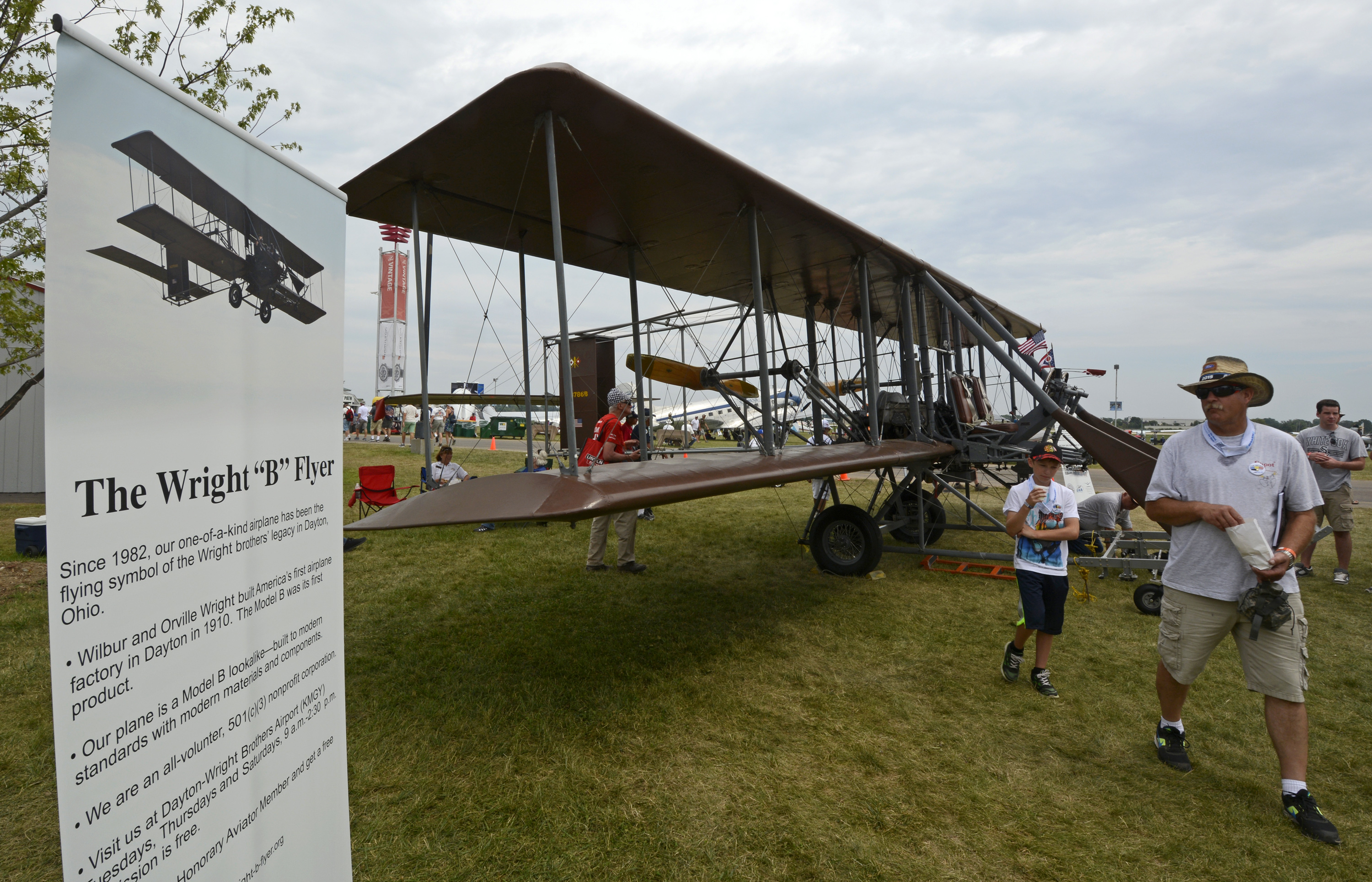
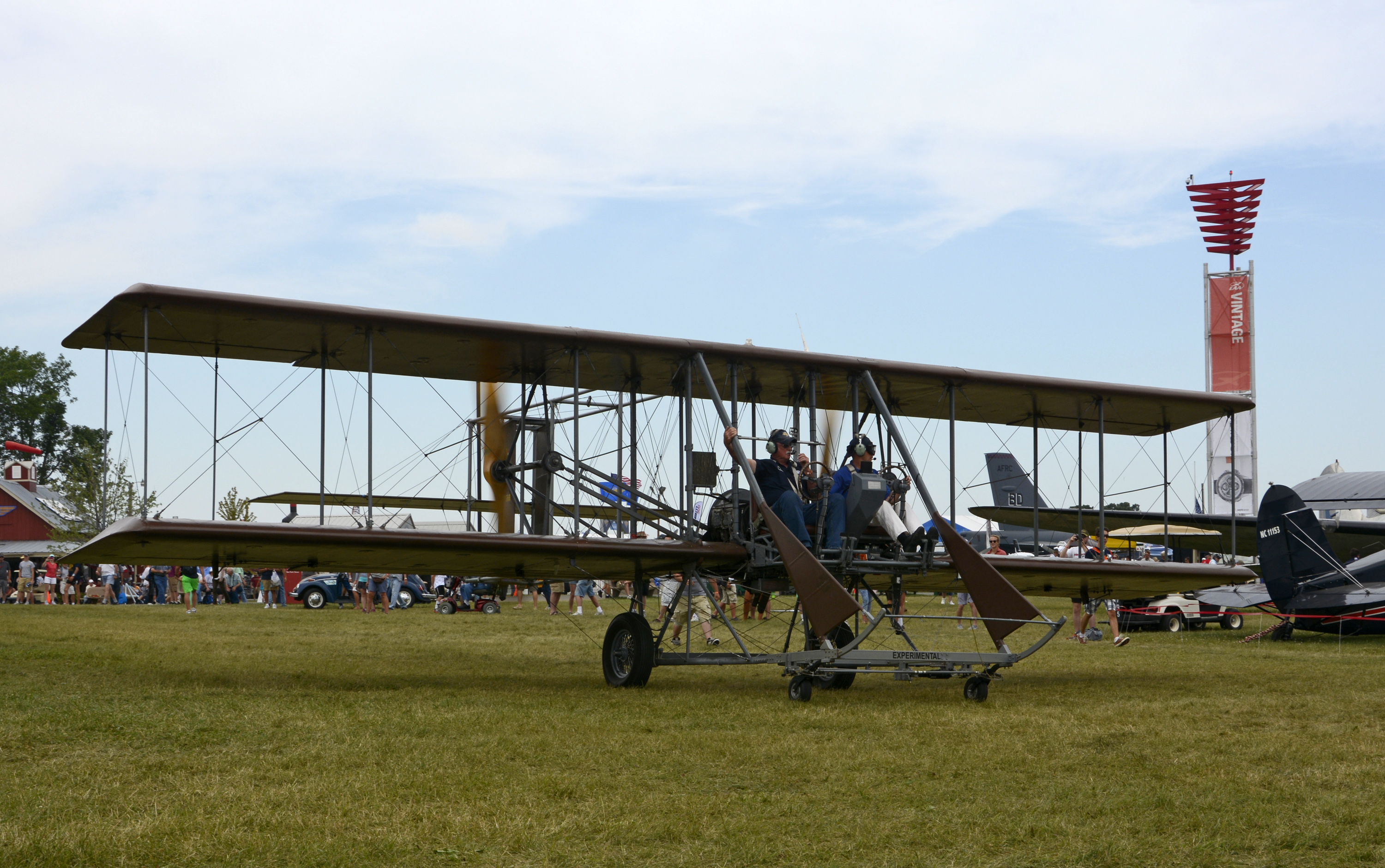
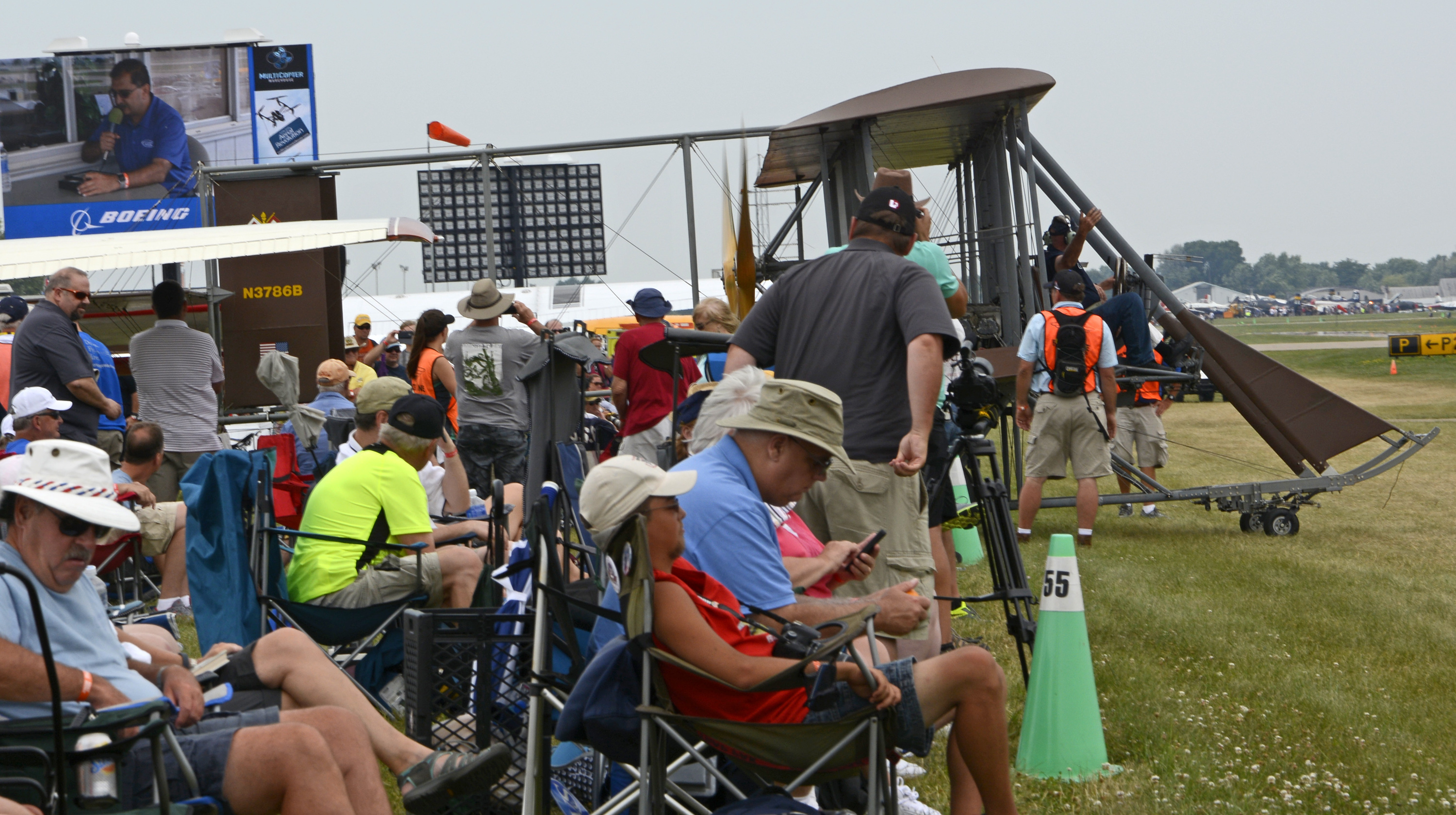
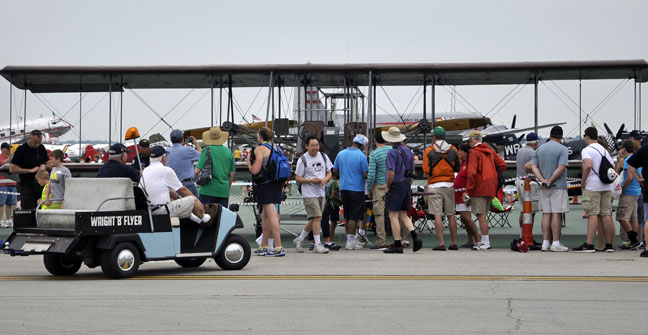
OSHKOSH, Wis.—The Wright B Flyer drew steady traffic on its fifth day of static display in the Vintage Area of the Experimental Aircraft Association’s (EAA’s) AirVenture 2015 on Wittman Airport. The Dayton-based nonprofit organization has continued to sign up EAA homebuilders who want to help build parts for the next Wright B Flyer, a modern lookalike of the Wright brothers’ first factory-built airplane. Here are some photos from Friday’s display.
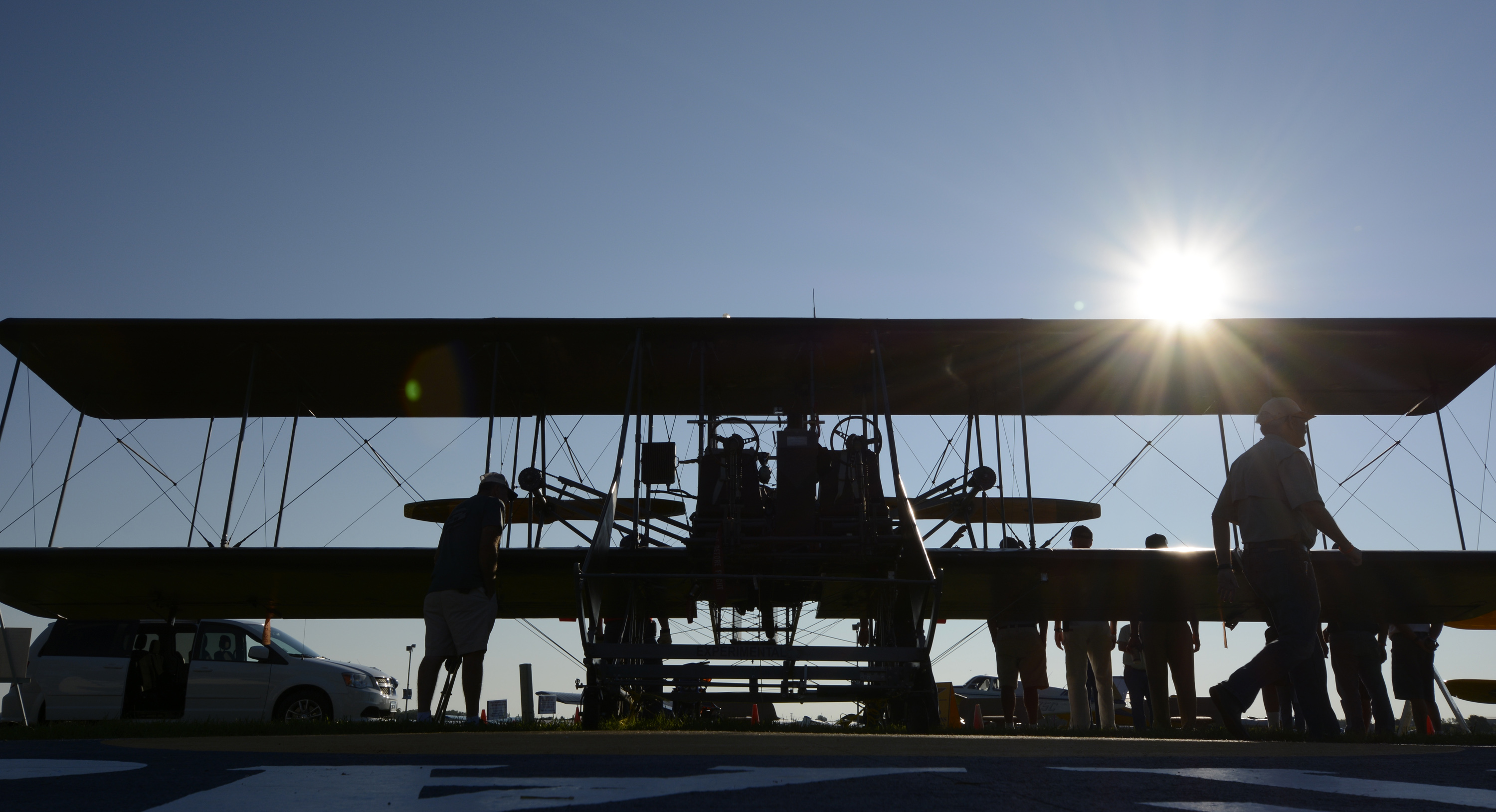
The Wright B Flyer is backlit by the morning sun as volunteers set it up for display on EAA’s new Vintage Plaza at EAA Airventure 2015. (Wright B Flyer photo by Timothy R. Gaffney.)
OSHKOSH, Wis.—The one-of-a-kind Wright B Flyer, a flyable lookalike of the Wright brothers’ first factory-built airplane, went on display in the Experimental Aircraft Association’s (EAA’s) AirVenture Vintage Area Monday following a nonstop trip from Dayton, Ohio—by truck.
Like every other airplane at EAA AirVenture, the Wright B Flyer is a flying machine. So why did Wright B Flyer’s volunteers haul it here in a semi trailer? Whey didn’t they just fly it here?
Here’s a pilot’s perspective on the Wright B Flyer by Rich Stepler, volunteer chief pilot:
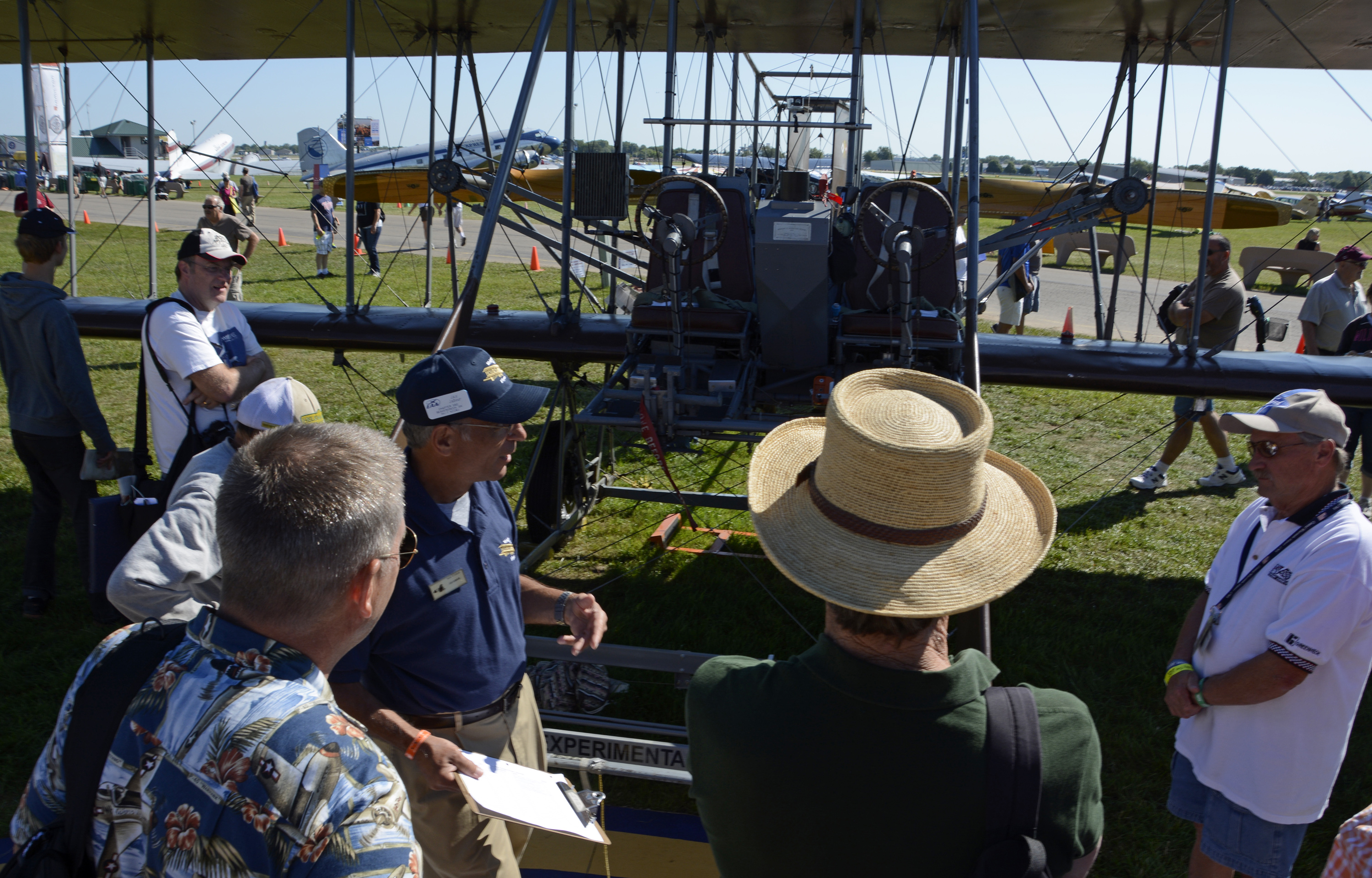
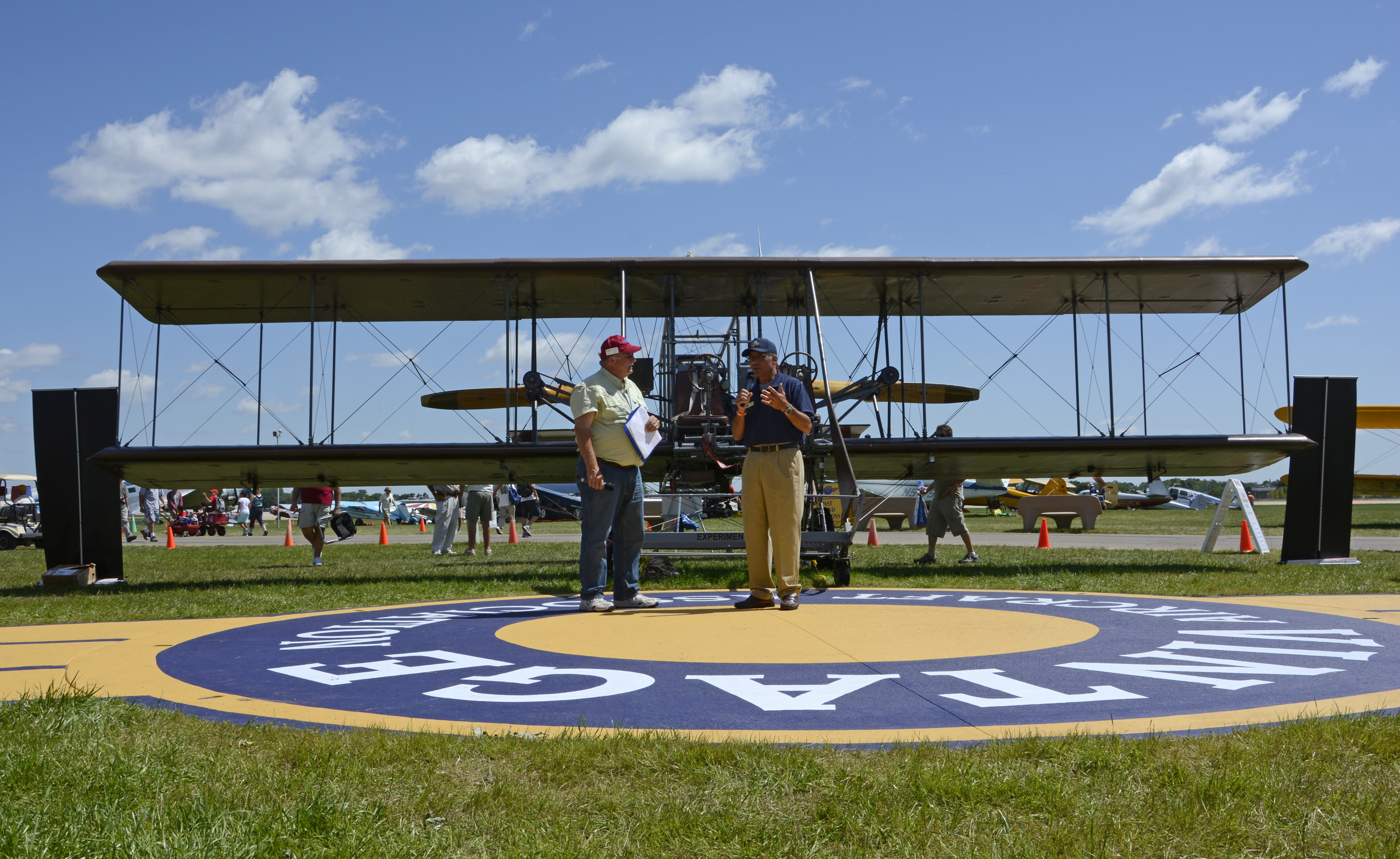
Wright B Flyer President Jay Jabour (with clipboard) tells homebuilders how they can help build the next Wright B Flyer. The airplane is on display on Vintage Square at EAA AirVenture 2015. (Wright B Flyer photo by Timothy R. Gaffney)
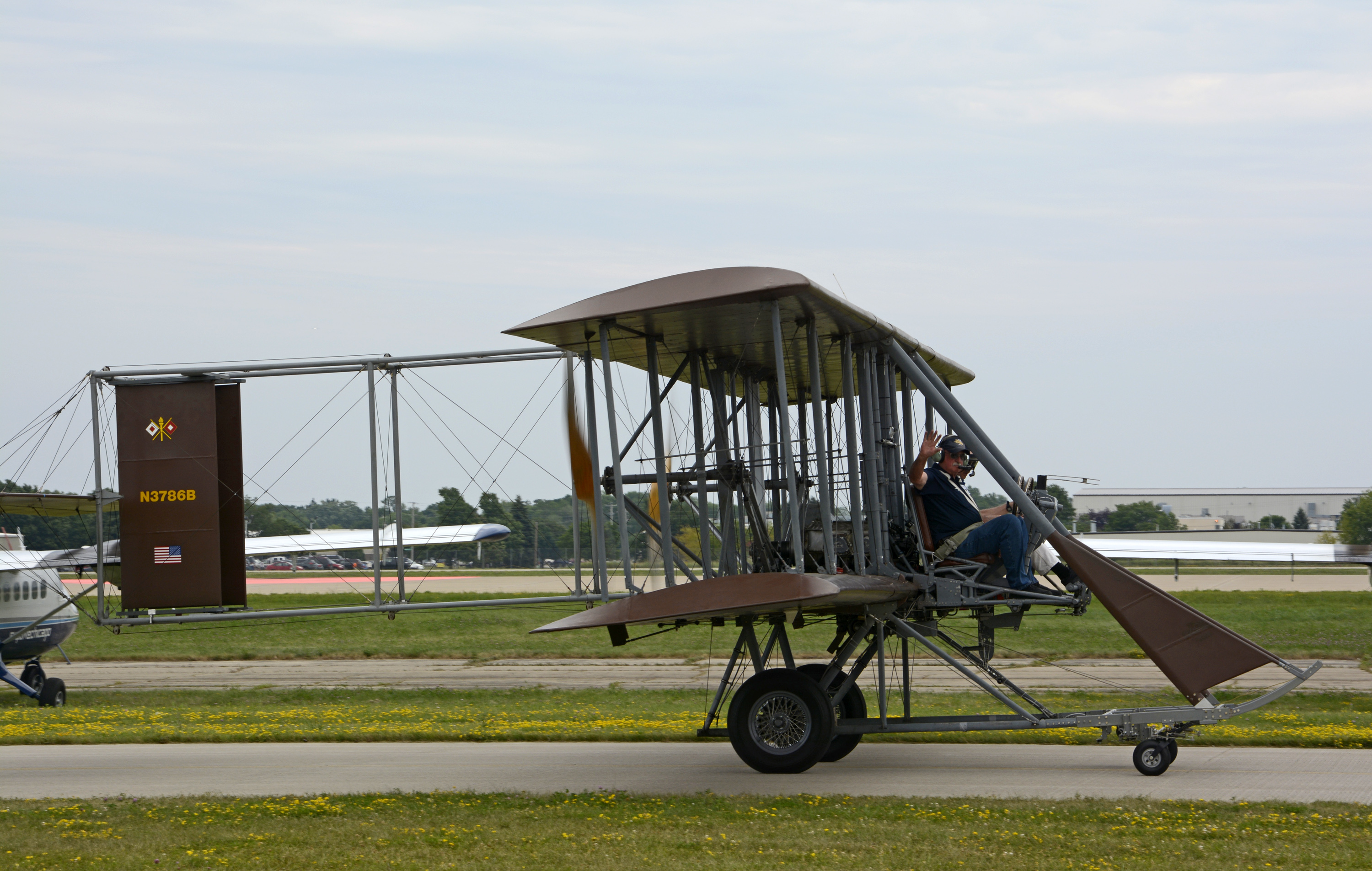
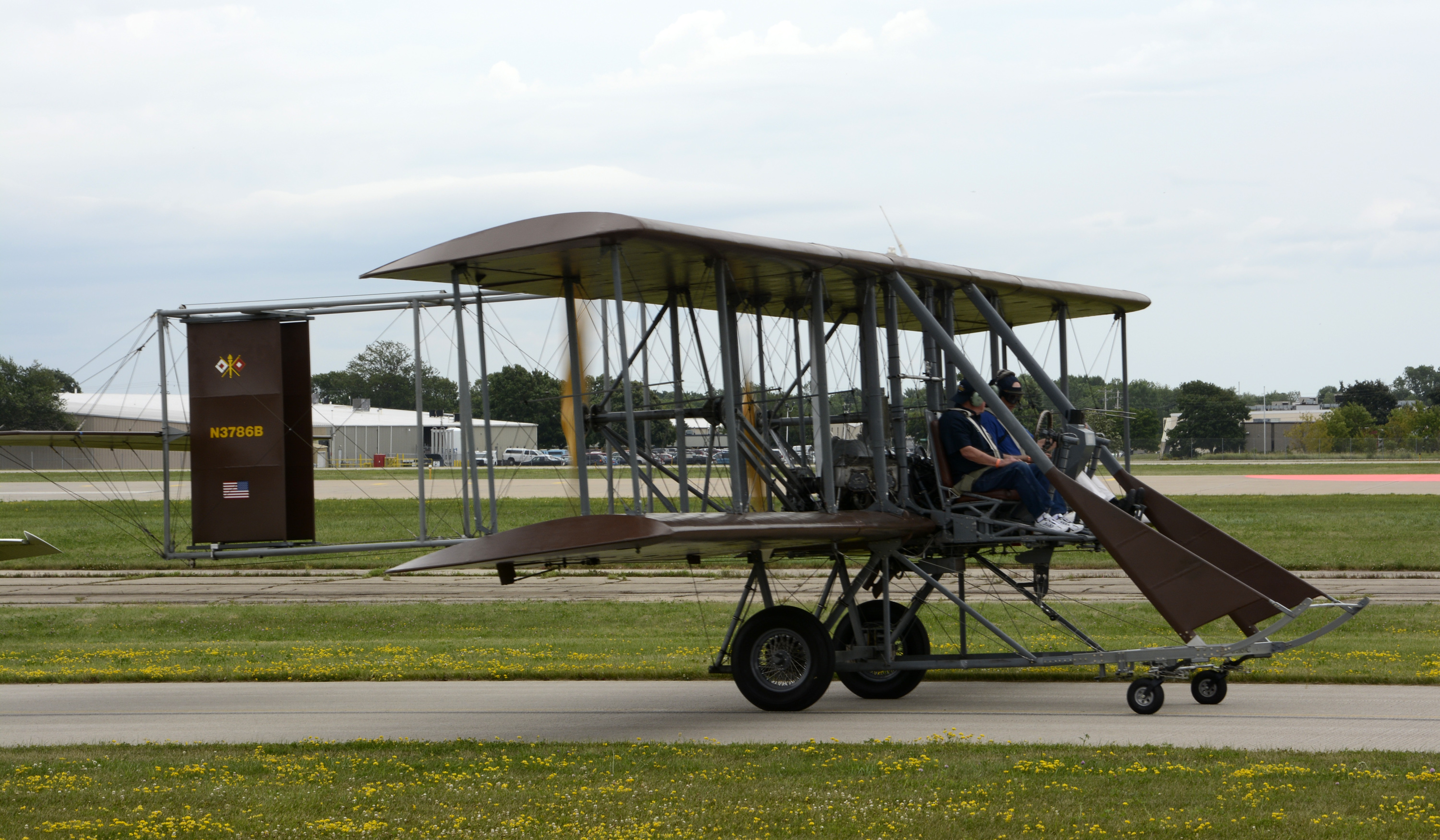
The Wright B Flyer (N3786B) is a VFR, day-only airplane that carries 28 gallons of usable fuel. Our engine, a Lycoming HIO-360, burns about 20 gallons an hour, to push our 3,400 pound, extremely draggy airframe through the sky. Since we cruise at about 50 mph, we need to plan routes with airports no more than 40 miles apart. That’s 16 stops between Dayton-Wright Brothers Airport (KMGY) and Wittman Field (KOSH).
If we were able to fly the route nonstop, it would take about nine hours of flight time. But every stop would add about an hour to the trip, giving us a block time of about 25 hours. We must avoid the Military Operating Areas in central Indiana and would be shunned by controllers of the class B airspace around Chicago, as we are so slow. This would make the trip about 385 nautical miles, or about 60 nm longer than flying victor airways.
Wright “B” Flyer taxies on Wittman Field at EAA AirVenture on Monday, July 20.
We try to avoid overflying metropolitan areas because our service ceiling is limited to a density altitude of about 3,000 feet MSL. The mid-day July temperatures in the midwest could prevent us from flying as we could not get to the FAA required 1,000 feet AGL over populated areas.
Selection of the airports for landing and refueling can also be a challenge. Out of ground effect, we can only sustain a 50 foot per minute rate of climb (it takes 10 minutes to get to 500 feet above ground level). The length of the runway is not as important as the height of the obstacles off the end of the runway.
There is no trim on the Wright B Flyer, no dihedral on the wings and very low wing loading. Piloting such a machine is very busy and tiring; after about 20 minutes, the pilot is usually begging the copilot to fly for a while.
Wright B Flyer President Jay Jabour speaks about the airplane on Vintage Plaza at EAA’s AirVenture 2015. Watching is Ray Johnson, EAA’s Vintage Area chairman.
We are severely limited by the wind; our takeoff and landing crosswind limit is 10 miles per hour.
Headwind is also a problem. On several occasions, when we flew the the airplane to Indianapolis Executive Airport for the Indianapolis air show, our first fuel stop was Richmond, Ind., about 30 miles west of our home airport. If the wind aloft had exceeded about 15 kt from the west, we would have burned burn half our fuel before we got halfway there, forcing a return to KMGY to refuel and wait for better conditions.
Flight planning for a cross country trip in the Wright B Flyer is not an easy task.
UPDATE June 18, 2015: A maintenance issue has forced Wright “B” Flyer to cancel its participation in the air show.
DAYTON, Ohio—Wright “B” Flyer Inc. will bring history to life this weekend at the Vectren Dayton Air Show Presented by Kroger with flybys of its one-of-a-kind lookalike of the Wright brothers’ first factory-built airplane.
The Wright “B” Flyer is a symbol of Dayton’s aviation heritage because the original Model B was produced in Dayton, where Wilbur and Orville Wright lived and invented the airplane. The Wright brothers formed the Wright Company in 1909 and produced approximately 120 airplanes in its West Dayton factory. The “B” was its first and most popular model.
The original Wright factory buildings—the first in America built for the purpose of manufacturing airplanes—are about to become active again.
Later this year, Wright “B” Flyer will begin building its next Model B lookalike at the factory site. The all-volunteer, 501(c)(3) nonprofit is raising funds for the project to build a successor to the current airplane, which has been flying since 1982. Most construction will take place in an adjoining building, but final assembly is to be accomplished in one of the original buildings.
The National Aviation Heritage Alliance (NAHA) and the Experimental Aircraft Association (EAA) are supporting the effort. NAHA is developing a workspace for the project at the factory site. EAA, a worldwide association of aviation enthusiasts based in Oshkosh, Wis., is helping Wright “B” Flyer recruit volunteers to help build parts for the airplane.
NAHA is a nonprofit organization designated by Congress to manage an eight-county area of southwestern Ohio known as the National Aviation Heritage Area. It’s one of 49 National Heritage Areas across the United States and the only one dedicated to aviation heritage. Wright “B” Flyer and the United States Air and Trade Show Inc., the air show’s governing body, are among the 16 heritage partners NAHA represents.
The Vectren Dayton Air Show is one of America’s top annual aviation events. This year’s headliner act will be the U.S. Air Force Thunderbirds. Joining them will be the U.S. Navy F-18 Super Hornet, U.S. Army Golden Knights and a U.S. Coast Guard search and rescue (SAR) demonstration. Making its first appearance in Dayton will be the Breitling Jet Team from Dijon, France, on its first North American Tour.
The show will also feature Jack Link’s Screamin’ Sasquatch Jet WACO, Mat Younkin’s Beech 18 aerobatics, the legendary Sean D. Tucker, the Shockwave Jet Truck and the Wright “B” Flyer, a lookalike of the Wright brothers’ first production airplane.
Discount general admission tickets are on sale at area Kroger Stores. The Greater Dayton RTA is offering Park & Ride express shuttle service from the National Museum of the U.S. Air Force. Gates are open 9 a.m. to 6 p.m. The feature show takes place from 11:30 a.m. to 4 p.m.